

On February 28, 2026, the United States and Israel launched a large-scale joint military strike against Iran, and the situation escalated rapidly.
U.S. President Donald Trump posted a video on social platforms, making it clear that the goal of the operation was to "overthrow the Iranian regime" and shouted to Tehran: "When the operation is over, it's time for your government to be replaced." ”
According to US media reports, this time it was not a small fight, but "far exceeded the scale of the attack on Iran's nuclear facilities in June last year." Israeli Prime Minister Benjamin Netanyahu also confirmed that the United States and Israel have joined forces to end the current Iranian regime.
Iran immediately counterattacked Israel with missiles and drones, the powder keg in the Middle East was ignited, the regional conflict was at risk of further spreading, and global markets were highly tense.
The impact on the capital market may be felt soon, and the market generally believes that the following sectors will be focused on:
Oil & Gas Extraction & Energy Prices, the Middle East is the world's most important oil and gas producing region. Once the conflict expands, Iran's exports (which produce about 3 million barrels of oil per day) may be interrupted, leading to tight global energy supply and driving up oil and gas prices.
The escalation of the war means a surge in demand for weapons such as missiles, drones, and air defense systems. Not only will the United States and Israel increase procurement, but neighboring countries may also accelerate armaments construction, and orders from military enterprises are expected to soar.
For tanker transportation, if key shipping lanes such as the Strait of Hormuz are threatened, detours or insurance costs may rise, and freight rates may jump.
Precious metals such as gold, as traditional safe-haven assets, often flock to gold when geopolitical risks heat up; Nuclear pollution prevention and control: If an attack involves a nuclear facility, the need for emergency response and monitoring may increase.
Oil prices no longer depend on supply and demand
At present, the crude oil market has switched from "economic logic" to "geopolitical model". High volatility is almost inevitable in the coming month.
If the conflict continues to ferment, oil prices could rise further. Investors can focus on two types of opportunities: upstream companies with oil and gas resources (such as oil extraction companies); Offshore oil and gas engineering and services companies – they benefit from the high oil price environment in the long term.
Kim Fustier, senior oil and gas analyst at HSBC, pointed out that Iran-related risks are "asymmetrical" for oil prices - the upside is much greater than the downside.
The key variable lies in the Strait of Hormuz – from which about 19% of the world's oil (1900–20 million barrels per day) is shipped. About 15 million barrels of this are crude oil, and the rest are refined oil products and liquefied petroleum gas (LPG). If this "world oil pipe" is interrupted even for a short time, Brent oil prices may quickly rush to $80 per barrel.
But don't forget that the fundamentals remain weak in the medium term. Despite short-term risks pushing up oil prices, HSBC maintains its long-term forecast of an average Brent price of $65 per barrel in 2026. Why?
The world currently produces about 2.3 million barrels of crude oil per day; OPEC+ still has a large amount of idle production capacity in its hands, which can increase production and price pressure at any time. Therefore, geopolitical conflicts can push up prices, but it is difficult to completely reverse the overall situation of oversupply.
The real risk is not "how much Iran produces", but "whether it can be shipped out".
Iran currently produces about 4.6 million barrels of liquid fuel per day, including 3.3 million barrels of crude oil, and exports 160–1.8 million barrels per day, mainly to East Asian countries. But if military strikes only target nuclear facilities or military targets, Iran's oil fields and export pipelines may not be shut down immediately — supplies will not collapse immediately.
The real "tipping point" is the transportation channel
If Iran retaliates in the Strait of Hormuz (such as blockades, attacks on oil tankers), the consequences will be far more serious than its own production cuts.
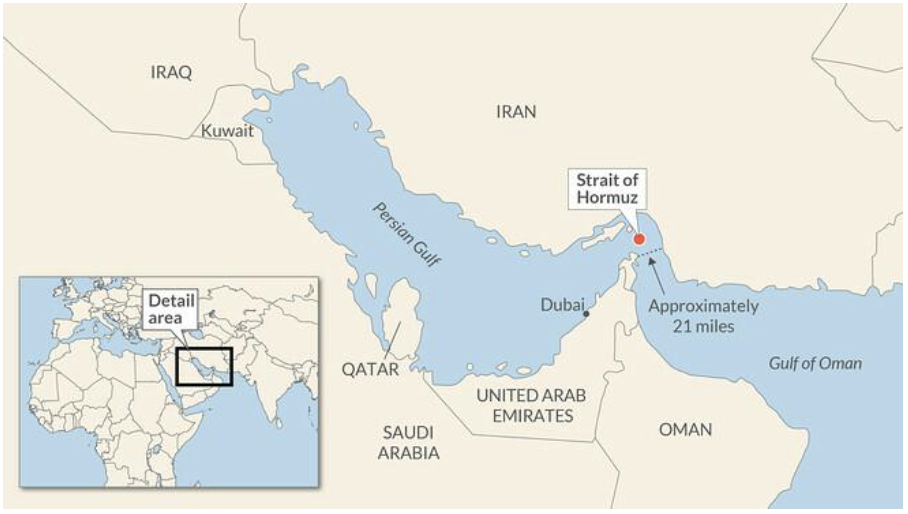
The alternative routes are very limited: the maximum capacity of the Saudi East-West pipeline is 7 million barrels per day, but the actual idle is only 200-4 million barrels; The Fujairah pipeline in the UAE will squeeze out up to 40–500,000 barrels; Combined, it is far from enough to make up for the gap left by Hormuz's interruption.
The precious metals market ushered in an all-round rise
Affected by the tension in the Middle East, gold and silver prices have risen sharply across the board, and safe-haven funds have poured into the precious metals market.
The international gold price once exceeded $5,300 per ounce, reaching a maximum of $5,308, rising more than 2% during the day, hitting a new high this year. silver rose even more violently, rushing to $95 per ounce, soaring more than 7% in a single day, and its performance was more "aggressive" than gold; The domestic market also followed suit: the main contract of Shanghai gold futures rose by 1.5%, and the main contract of Shanghai silver futures rose by 7.2%.
Why is gold and silver so strong?
Gold: It is both a traditional "safe-haven asset" and a hedge against inflation. The current escalation of the conflict + the continued buying of gold by many central banks around the world + the market expects the Federal Reserve to cut interest rates, and the triple positive superposition pushes up the price of gold.
Silver: Not only has financial hedging properties, but is also widely used in photovoltaic, electronics and other industrial fields. Under the panic, funds not only use it as a "safe harbor" but also bet on future economic recovery, so it has become the "preferred target for safe-haven funds".
The situation is still changing rapidly
Iran has not yet announced a full-scale counterattack, and there are more and more international calls for "calm".
But one thing has been determined: this joint operation between the United States and Israel has completely broken the original balance of power in the Middle East. Now, the trend of oil and gold prices is no longer mainly based on economic data, but on geopolitical risks. In other words: the "baton" of market pricing has been temporarily handed over to the battlefield.
In the coming days, investors will be watching three key signals:
How does Iran retaliate? Is it a small-scale response, or a direct hit on energy or shipping targets?
Will the United States further expand its military involvement?
Are tanker shipments blocked in the Strait of Hormuz? (This is the only way to get nearly one-fifth of the world's oil)
As long as there is no clear "cooling" answer to these three questions, oil and gold are likely to continue to fluctuate violently at high levels - both rise and fall quickly and volatility increases.