
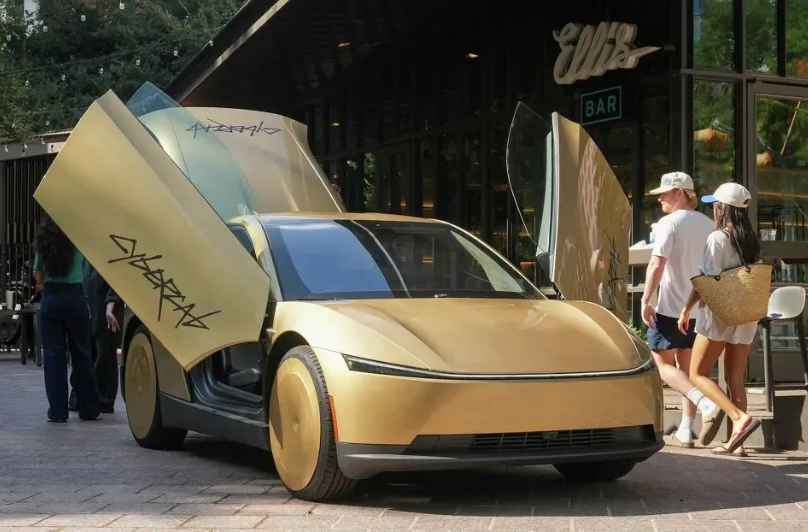
Recently, Tesla made a major move in Austin, Texas—officially launching the mass-produced Cybercab driverless taxi and simultaneously launching paid operations in parts of Austin.
But the tone of this launch event was completely different from Tesla's usual grand gestures: strict invitation-only, no live streaming, invitees signing confidentiality agreements, and even media reporters were kept out. Musk repeatedly posted warm-up messages on X, posting the phrase "The Cybercab storm is coming," prompting the capital market to respond positively in advance—on September 3rd, Tesla's stock price rose 5.42%, closing at $376.37.
However, behind the "mystery" of the launch event, there are actually only three questions investors should focus on: Is this car really good? Can it be scaled up? And, will regulators release the rules?
| A "non-traditional" car: no steering wheel, but made entirely for operation
The Cybercab is a model that completely overturns traditional automotive design logic—two-seater, two-door, butterfly doors, completely eliminating the steering wheel, accelerator, brake pedals, and mirrors, relying entirely on Tesla's FSD pure vision autonomous driving system.
But if you think it's just a "show-off" concept car, you're gravely mistaken. Every design detail of Cybercab points to the same goal: to minimize the operating cost per vehicle.

Let's look at the hardware specs first:
Price: The target is to keep it under $30,000. According to Aijian Securities' estimates, the per-vehicle manufacturing cost has dropped to the $23,000–$25,000 range. Battery: Approximately 48kWh lithium-ion battery pack, combined range of about 673 kilometers. Weight: Curb weight is only 1412 kg, 300-600 kg lighter than pure electric sedans in the same class. Energy consumption: about 10.2 kWh per 100 kilometers, with a travel cost of about 0.8 RMB per kilometer Operational goal: Keep operating costs per mile under $0.2, about 20% of traditional ride-hailing costs.
In short: Cybercab is not a "car for people to drive," but a "mobile terminal born to make money."
|From concept to street: 45 cars "small steps and quick run"
The concept of Cybercab first debuted at the "We, Robot" event in October 2024, but Musk's obsession with Robotaxi dates back to 2016. It took only about 18 months from concept to mass production—far faster than traditional automakers typically develop a conventional model.
Currently, Tesla has registered 420 autonomous vehicles in Texas, including 45 Cybercab models and about 375 Robotaxi Model Y. For comparison, Waymo registered 988 autonomous vehicles in Texas, maintaining its leading scale.
On the day of release, the Tesla Robotaxi App was updated simultaneously, allowing passengers to choose either the Model Y or Cybercab in certain areas of Austin. At the same time, Tesla's official website quietly launched a Cybercab procurement intention form for commercial users, beginning preparations for third-party fleet collaborations.
However, it should be noted that these 45 vehicles currently operate only in specific areas of Austin, and passengers cannot currently choose their model proactively; the system will automatically assign vehicles based on availability. Children under 13 are strictly prohibited from riding the Cybercab, and children under 8 are not allowed to ride in the Model Y Robotaxi.
| Three Unavoidable "Hard Thresholds"
Despite the product demonstration attracting attention, Cybercab still needs to overcome at least three rigid hurdles to realize the "storm" Musk spoke of.
Threshold One: Regulation
This is the greatest uncertainty. Cybercab has completely eliminated steering wheels and pedals, directly challenging the strict requirement in the U.S. Federal Motor Vehicle Safety Standard (FMVSS) that "vehicles must be equipped with driver control devices."
The current situation is as follows:
Tesla claims the Cybercab "fully meets all current federal motor vehicle safety standards," does not require an exemption, and is not subject to the annual production cap of 2,500 vehicles However, NHTSA has initiated a special assessment process, focusing on reviewing its compliance. In California, Tesla only holds a charter carrier license, not an autonomous driving operation license, and the FSD system is still defined locally as Level 2 assisted driving. In most regions worldwide, current regulations still mandate manual operation devices, making it difficult for Cybercab to expand beyond North America in the short term.
Threshold 2: Security data
Tesla has yet to release complete security operations data for Cybercab. However, previously disclosed supervised autonomous vehicle fleet accidents were one per 57,000 miles, about four times that of human drivers (one per 229,000 miles). Musk himself admitted that there are still software issues, and in some scenarios, vehicles may "not dare to move" or fall into a vicious cycle.
Pure vision solutions face physical limitations in extreme scenarios such as strong light and low visibility, which cannot be fully overcome by software iteration. In the event of a major accident, regulatory scrutiny may suddenly tighten.
Threshold Three: Ramp-up capacity
Cybercab's "Unboxed" manufacturing process is a brand-new production system, with a target beat of one vehicle rolling off the line every 10 seconds. The Texas factory plans 12 production lines with a full annual capacity of 2.4 million vehicles. However, this process has yet to undergo large-scale industrial validation at the million-level level, and the 4680 battery capacity supports multiple models simultaneously, with limited initial delivery scale.
Musk himself admitted: "Initial capacity will be very slow, and will gradually ramp up by the end of the year." "
Jingtai's Perspective | Moving from "concept speculation" to the "order validation" stage
The mass production launch of Cybercab marks the official transition of the Robotaxi track from the PPT stage to the actual operational phase. But at this stage, the real beneficiaries are not the "concept stocks," but the industry chain segments with actual order fulfillment capabilities.
Focus areas:
Autonomous driving sensors and chips: If the pure vision route is validated, demand for camera modules and AI inference chips will continue to grow. Drive-by-wire chassis: The core component of models without a steering wheel, with high technical barriers. High-precision positioning and mapping: Although Tesla claims it does not rely on high-precision maps, the overall industry trend still requires positioning infrastructure support.
Traditional mobility platforms—structural pressures are accumulating
If Cybercab can operate stably at a cost of $0.2 per mile, the "driver + platform" model relied upon by Uber and Lyft will face fundamental challenges. Traditional ride-hailing platforms will be forced to accelerate their transition to autonomous driving or restructure profit-sharing mechanisms.
Focus areas: Uber and Lyft's autonomous driving strategic layouts, as well as their cooperation or competition dynamics with Tesla and Waymo.
Tesla itself—the valuation logic is shifting
Wall Street is redefining Tesla: shifting from a "car manufacturer" to an "AI + mobility platform." Of Morgan Stanley's $400 target price, the Robotaxi business contributed $120-166 in value, accounting for over 40%. Bank of America even valued Tesla's autonomous taxi business at $844 billion, about half of its total valuation.
However, Goldman Sachs also cautioned that Robotaxi will remain a low proportion of Tesla's total revenue in 2026-2027, and current valuations partially reflect optimistic expectations.
Two key observation indicators:
Fleet expansion speed: 45 vehicles→ 100 → 500 vehicles—this is the real verification. Morgan Stanley clearly stated that if Tesla can deploy 25-50 Cybercabs in Texas within a few weeks after the event, the stock price will receive a positive response; If it were just "another demo," the market would be disappointed.
Regulatory progress: NHTSA assessment conclusions, California operating licenses, and legislative progress on the Autonomous Driving Act—these three variables determine whether Cybercab can move beyond Texas and nationwide.
For investors, the most important thing right now is not to chase the rally of the "Robotaxi concept," but to focus on two key figures: Cybercab's real operational data in Austin and NHTSA's assessment conclusions.
As for the "golden age of transportation"? Musk himself said—"This is the beginning of a journey, not the end." "