

A new round of US-Iran negotiations continues, and US stocks have repeatedly hit new highs, but risks are quietly accumulating.
On April 25, a team focused on index trading under Goldman Sachs issued a warning: although the stock market has risen continuously and the S&P 500 index has hit a record high, tensions in the Strait of Hormuz in the Middle East have not eased at all.
Rich Privorotsky, head of the Goldman Sachs team, said: "It's easy to start negotiations, but it's hard to really solve the problem. ”
At present, crude oil prices are rising and inventories are rapidly decreasing, but the stock market seems to be completely ignored and continues to soar.
At present, the market is betting almost all its enthusiasm on the "AI-driven demand" story, and the focus is shifting from GPUs (graphics chips) to more upstream links - such as CPUs (general-purpose processors) and optical communication equipment.
Strait of Hormuz: The ceasefire is unstable, and oil inventories are in urgent need
A Goldman Sachs trading team pointed out that despite the apparent ceasefire, the actual situation in the Strait of Hormuz has not really improved. The current ceasefire is fragile and generally not optimistic – with less than a 40% chance of resolving the problem by the end of May.
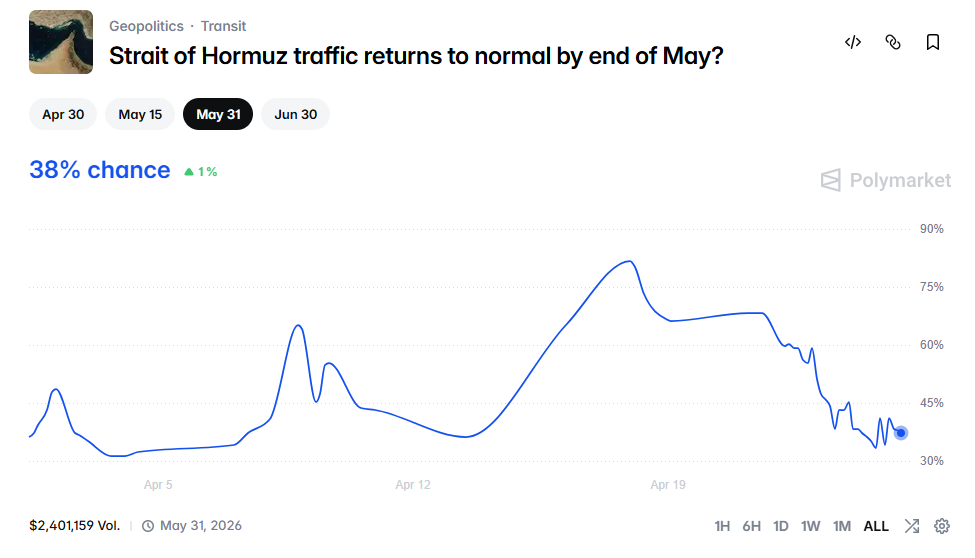
The more pressing issue is in "inventory".
Goldman Sachs trader Rich Privorotsky said oil inventories are being depleted rapidly, and with each day the strait is unclear, the problem becomes more complex and difficult to solve.
The market has sent a clear signal: the prices of gasoline, diesel and heating oil are all constantly hitting new highs.
The reasons for this tension include chaotic tanker scheduling, limited refinery capacity, and a tight overall supply of refined oil. Privorotsky stressed that even if there is good news in the future, these effects will not disappear immediately and will continue for some time.
From an investment perspective, Goldman Sachs suggests that the most effective operation at present is to buy Brent crude oil futures expiring in December 2026 (i.e., "go long"), betting that oil prices will continue to rise.
The focus shifts from GPUs to CPUs and optical communications
The reason why the stock market is "blind" to energy risks is largely because the first-quarter results of technology companies are too eye-catching.
Goldman Sachs trader Privorotsky pointed out that the market is now most concerned about the demand brought by AI. For example, Siemens Energy received large orders that exceeded expectations, and Intel's financial report also far exceeded expectations, all of which reinforce a consensus: AI needs more computing power, more power, and more infrastructure.
However, the story is escalating – the initial focus on GPUs (graphics chips) is now expanding into a broader range of AI "infrastructure" areas, such as CPUs (general-purpose processors) and optical communications (optical transceivers for high-speed data transmission).
At the same time, the entire AI supply chain has also begun to "shout tired": memory (DRAM), chip packaging, power supply, cooling system and other links have shown signs of shortage, becoming a new bottleneck.
Market sentiment has been fully reflected in the price: the Philadelphia Semiconductor ETF (representing the world's major chip stocks) has risen for 18 consecutive trading days, setting a record high, indicating that investors' optimistic expectations for the future of AI have been heavily priced into the current stock price.
Market technical signals are weakening, and risks are quietly rising
Goldman Sachs trader Privorotsky pointed out that the current rise in US stocks is highly linked to energy prices - as soon as oil prices rise, the stock market also rises, as if it is a "reflection".
But his model shows that we are now in the stage of "end of the economic cycle + monetary tightening". Historically, these periods have often been the worst times for stocks, often accompanied by rising long-term interest rates and flattening of the yield curve (i.e., narrowing of short- and long-term spreads).
Another notable phenomenon is the divergence between short-term interest rates and stock market movements.
If oil prices fall, this divergence may be fixed; But if oil prices continue to be high, the divergence will only increase and market volatility may increase.
From a volatility perspective:
The European market is currently in a state of "short gamma" (meaning insufficient hedging and easy to amplify the decline); After a rapid rebound, the US market may re-enter the "long gamma" range (relatively more stable), but this may not be sustainable.
Let's look at the investor's position:
An index representing active fund managers in the United States (NAAIM) has risen to 94 (near full positions), indicating that everyone's risk appetite has suddenly become very high - which is often a sign that the market is overheated.
Moreover, as the end of the month approaches, U.S. stocks are facing one of the strongest "month-end rebalancing selling pressures" in history (referring to passive selling caused by institutional rebalancing).
Taken together, Privorotsky believes:
The technical momentum driving the stock market rally is weakening, the favorable situation of "rising more and falling less" (i.e., the "asymmetric advantage") of the past is disappearing, and risks are beginning to tilt downward. He said: "From a more macro perspective, the buying momentum is significantly less than before. I have always been cautious about my current position and will continue to do so in the future. ”
Jingtai View|We must not only embrace AI, but also fasten our seat belts
The market always oscillates between "narrative" and "reality". AI represents the future, but the Strait of Hormuz determines whether construction can start smoothly tomorrow.
Goldman Sachs is not bearish, but reminds not to treat beta as alpha. When everyone believes that "AI never sleeps", the real risk often comes from the corner you ignore the most.
Strategy 1: The main line of AI can still be held, but it must be "de-bubbled"
focus on leaders with real orders, cash flow, and supply chain control (such as Nvidia, TSMC, ASML); Be wary of small and medium-cap AI stocks that are pure concept speculation and have no profit support.
Strategy 2: Increase energy allocation and commodity hedging
crude oil, natural gas, and refining and chemical sectors have dual support of event-driven + inventory cycle; Tail risk protection can be built through commodity ETFs or far-month futures.
Strategy 3: Control the overall position and be wary of fluctuations in May
After a sharp rise in April, May faced the triple pressure of earnings window + geopolitical uncertainty + month-end rebalancing; It is recommended to transfer part of the profits to cash or defensive assets (utilities, essential consumption).